WHY CHRIS KAVANAGH WAS ALLOWED TO REFEREE LIVERPOOL VS MAN CITY DESPITE BEING BORN IN GREATER MANCHESTER
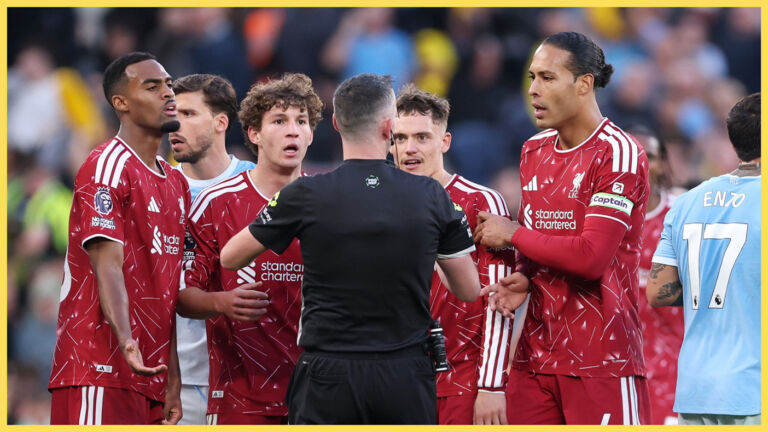
Chris Kavanagh has faced heavy criticism following his performance during Liverpool’s Premier League meeting with Manchester City at Anfield, particularly over his controversial decision to send off Ryan Gravenberch.
However, questions have also been raised about why Kavanagh was appointed to officiate the high-profile fixture despite being born in Greater Manchester, the same region associated with Manchester City.
Why Chris Kavanagh Was Eligible to Officiate the Match
Kavanagh’s appointment was permitted because his declared allegiance is to non-league club Droylsden FC, rather than Manchester City or Liverpool.
The 41-year-old referee became a major talking point after Gravenberch received a second yellow card during Liverpool’s 3-0 defeat to City on Sunday.
Liverpool head coach Andoni Iraola and former Reds defender Jamie Carragher were among those who questioned the official’s decisions.
Iraola expressed his frustration with Gravenberch’s first booking, arguing that the challenge on Elliot Anderson did not deserve a yellow card. The midfielder was subsequently sent off after a foul on Jeremy Doku.
The dismissal proved costly for Liverpool, with Erling Haaland scoring just three minutes later. Doku and Rayan Cherki then added further goals to complete City’s 3-0 victory.
Following the match, some Liverpool supporters questioned Kavanagh’s suitability for the fixture because of his Greater Manchester birthplace.
However, being born in a particular region does not automatically prevent a referee from officiating a match involving a club from that area.
What the Premier League Rules Say
According to the PGMOL appointments policy, referees, VAR officials and assistant VAR officials must declare their interests before the start of each season.
This includes identifying the football club they support so that potential conflicts of interest can be assessed before match appointments are made.
Officials cannot be assigned to matches involving clubs where their declared allegiance would create a conflict of interest.
The rules also cover clubs that have a strong association with a team supported by an official. PGMOL determines whether such a relationship creates a conflict that would make an appointment inappropriate.
In Kavanagh’s case, his support for Droylsden FC was not considered a conflict that prevented him from refereeing Liverpool against Manchester City.
Consequently, his birthplace alone was not sufficient grounds to rule him out of the fixture.
Jamie Carragher Slams Gravenberch’s Red Card
Kavanagh’s handling of Gravenberch’s dismissal became one of the most debated incidents of the match.
Speaking after the game on Sky Sports, Carragher described the decision to show the Liverpool midfielder a second yellow card as shocking.
The former Liverpool defender argued that Kavanagh had initially appeared unlikely to book Gravenberch for the challenge on Anderson, but changed his decision after noticing the opponent was hurt.
Carragher insisted that a player’s reaction to a challenge should not determine whether the incident deserves a yellow card.
He also questioned whether the challenge was serious enough to warrant a foul, arguing that the referee’s decision was particularly poor.
The controversy has continued to fuel debate among Liverpool supporters about the standard of officiating in the Premier League.
Ultimately, Kavanagh was permitted to referee the match because his declared club allegiance did not present a disqualifying conflict of interest under the relevant appointments policy. His Greater Manchester birthplace, on its own, did not make him ineligible.