For several years, Tottenham Hotspur have struggled to recreate the magic of the Mauricio Pochettino era.
Although the Argentine manager did not deliver a trophy during his time in north London, he transformed Spurs into a serious force and guided them all the way to a Champions League final.
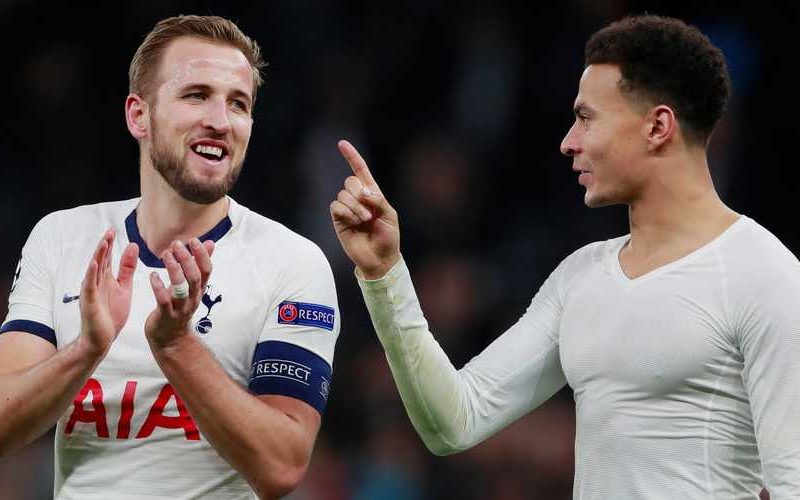
Pochettino also played a major role in the development of several players who went on to become Premier League stars. Harry Kane became Tottenham’s all-time leading goalscorer, while Dele Alli emerged as one of the most exciting young talents the club had produced in years. Christian Eriksen and Mousa Dembele were also key members of that side.
Dembele, in particular, was a truly exceptional midfielder and deserves to be remembered among the finest central midfielders to play in the Premier League.
What made Dembele so special?
Dembele possessed a rare combination of strength, technique and ball control. Operating as a box-to-box midfielder, the Belgian could effortlessly carry the ball through midfield and glide past opponents.
In many ways, he looked like an Eden Hazard playing in central midfield.
His ability on the ball was so impressive that Kyle Walker once described him as “probably the best dribbler I’ve ever seen.”
Those outside Tottenham may have forgotten just how good Dembele was. He never accumulated the same level of individual recognition as players such as Kevin De Bruyne or David Silva, which has contributed to him being somewhat underrated.
Inside the Spurs dressing room, however, there was never any doubt about his quality. Eric Dier once perfectly summed him up by describing Dembele as “a monster” who somehow also had “ballerina feet.”
His numbers during his peak underline just how dominant he could be. In the 2016/17 campaign, Dembele averaged 3.4 successful dribbles per game. Only six players in the entire Premier League recorded more, while no central midfielder managed to surpass him.
He also averaged 2.8 tackles per match, a figure that placed him among the most productive midfielders in the division.
Considering those numbers and the unique qualities he brought to Tottenham, it is hardly surprising that the club have struggled to find a genuine replacement since his departure in 2019.
Why have Spurs struggled to replace Dembele?
Tottenham have developed something of a habit of struggling to replace their biggest stars.
Kane and Son are obvious examples. Both became hugely important figures for the club, and replacing their production and influence has proved extremely difficult.
The same problem has existed in midfield, particularly when it comes to replacing Dembele.
Spurs initially looked to Tanguy Ndombele as the man capable of filling that void, but his spell at the club did not work out as hoped.
Since then, Tottenham’s midfield has often lacked the power, elegance and ability to progress the ball that Dembele provided so naturally.
The less said about the Harry Winks, Oliver Skipp and Pierre-Emile Højbjerg era, the better. Moussa Sissoko’s time in north London also failed to provide a genuine solution to the problem.
Midfield remained one of Tottenham’s biggest weaknesses during the 2025/26 campaign. That was one of the reasons the club invested heavily in Sandro Tonali and Mateus Fernandes.
The idea was to add more progressive midfielders capable of breaking lines and moving the ball forward in a way that would provide some of the qualities Dembele once brought to the team.
So far, however, the experiment has not produced the desired results.
For a player who cost around £100m, Tottenham are still waiting to see the very best of Tonali. Fernandes, meanwhile, has surprisingly been deployed as a No.10 by Roberto De Zerbi rather than operating deeper in midfield.
That raises an obvious question: where will Tottenham finally find their next Dembele?
Could Tottenham’s next Dembele already be at the club?
Tottenham currently have plenty of problems to solve. One of the most obvious has been their lack of attacking production, with De Zerbi’s team taking five Premier League matches before finally finding the net.
Despite spending around £185m on midfield reinforcements, those central areas remain a concern.
Rodrigo Bentancur has arguably been the standout performer, even outshining the two major midfield additions. That in itself could be viewed as a concern, especially when considering the money invested in the position.
But there is another name who could eventually change the conversation: Luca Williams-Barnett.
The teenage midfielder has already drawn comparisons with Arsenal youngster Max Dowman. While he has not yet been given the same level of regular first-team opportunities, Tottenham may soon have to give their academy star a bigger role.
Williams-Barnett showed during pre-season that he is capable of competing against senior players.
The youngster has been impressing at youth level for some time. Last season, he scored 16 goals in 19 youth-team appearances while also registering eight assists across different competitions.
Despite those numbers, he has made just two competitive first-team appearances.
Given what he produced during pre-season, that limited involvement is somewhat surprising.
Following an impressive display against Auckland, fellow academy graduate Mikey Moore described Williams-Barnett as an “unbelievable footballer”, while Ben Davies labelled him “a really top player” and backed him to have a “bright future.”
Against Auckland, Williams-Barnett operated as an attacking midfielder and managed five shots during his 63 minutes on the pitch. He came close to scoring and eventually got his pre-season goal in the final match against Hoffenheim.
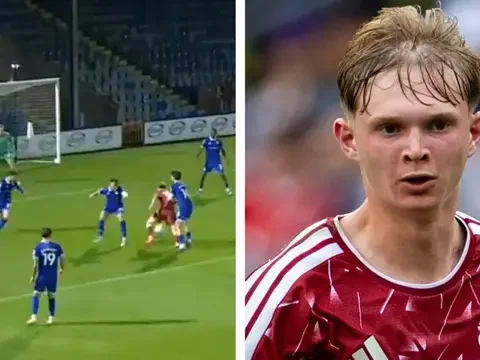
However, his most convincing performance may have come against MK Dons.
Williams-Barnett vs MK Dons
– Minutes: 45
– Touches: 33
– Accurate passes: 20/22 (91%)
– Key passes: 3
– Shots: 1
– Successful dribbles: 2/6
– Carries: 14
– Duels won: 3/8
Williams-Barnett came on during the second half and was deployed in a deeper midfield position.
That role brought back memories of Dembele.
He completed 91% of his passes, created three chances and attempted six dribbles during his 45 minutes on the pitch. More importantly, he repeatedly carried the ball beyond opponents and drove Tottenham into dangerous areas.
That ability to escape pressure could become one of his biggest weapons.
Williams-Barnett has consistently shown at youth level that he is extremely difficult to dispossess. His close control and ability to manoeuvre away from defenders make him particularly dangerous when carrying the ball through crowded areas.
His long-term future could ultimately be in a more advanced position.
However, if De Zerbi eventually develops him into a deeper midfielder, Tottenham could potentially have their own version of Dembele emerging from within the academy.
For a club that has spent years searching for a replacement, the answer may already be sitting in their own ranks.