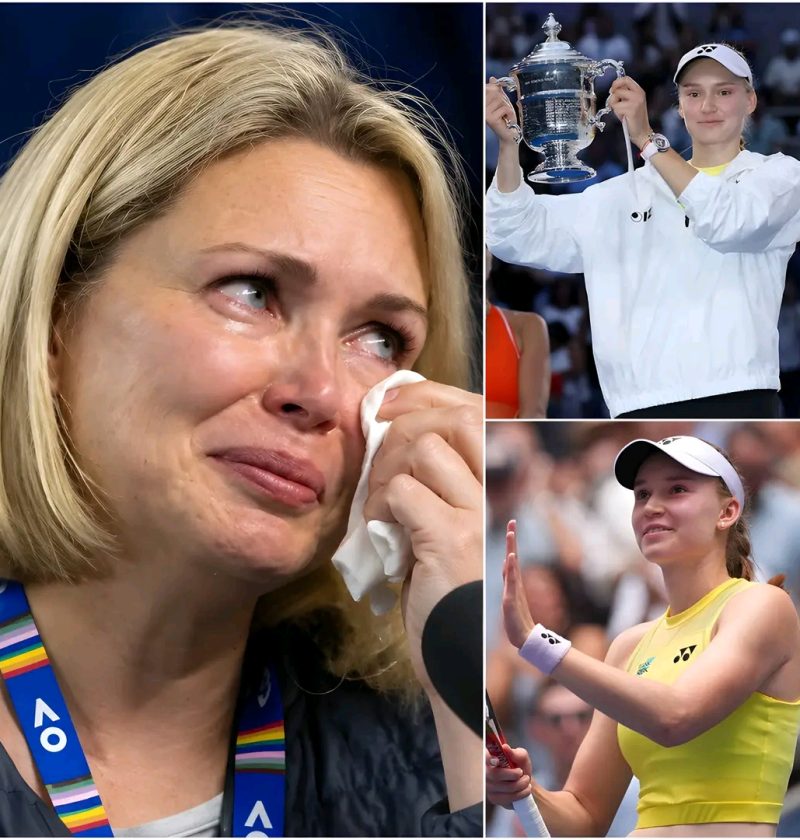
“MY DAUGHTER DID NOTHING WRONG!” — Elena Rybakina’s Mother Defends Her After US Open Controversy
Elena Rybakina’s mother has strongly defended her daughter following criticism surrounding the 2026 US Open final and accusations that the tennis star deliberately took too much time between serves to disturb Aryna Sabalenka’s rhythm.
What began as a major championship victory soon became surrounded by debate over Rybakina’s serving routine. With the final taking place under intense scrutiny, some observers questioned whether the Kazakh player was intentionally slowing down her preparation before points.
Rybakina faced Sabalenka in a highly anticipated final between two of the sport’s biggest hitters. While the match itself attracted plenty of attention, discussion continued afterward as fans and commentators focused on the time Rybakina appeared to take between serves.
However, supporters of Rybakina argued that her routine should not automatically be viewed as an attempt to gain an unfair advantage. Players have different preparation habits and serving rhythms, and taking additional time does not necessarily mean that a player is deliberately trying to frustrate an opponent.
The situation became more personal when Rybakina’s mother reportedly came to her daughter’s defense. Her position was that Rybakina had not intentionally done anything wrong and should not be portrayed as someone who was attempting to manipulate the match.
For the family, the criticism was particularly difficult because it went beyond questioning a particular moment and appeared to raise questions about Rybakina’s character and sporting conduct.
The controversy also highlighted the fine line between normal competitive routines and gamesmanship in professional tennis. A player’s preparation before a serve can naturally affect an opponent’s concentration, but that does not automatically prove that the effect was intentional.
Sabalenka’s experience of the situation is also an important part of the discussion. A player waiting for an opponent to serve may experience a delay very differently from officials or spectators watching the match from outside.
Rybakina’s mother reportedly referred to video footage and an interaction involving the umpire as part of her defense. Such evidence could provide additional context about what happened before and during the disputed moments.
Video footage can be particularly useful in situations like this because short clips shared online may not show the complete sequence. What appears suspicious in an isolated clip could look different when the surrounding events are taken into account.
The involvement of the umpire is also significant because officials are responsible for monitoring the timing and enforcing the rules during a match. Any communication between a player and the umpire could potentially help explain what was happening at the time.
At the same time, the available information does not automatically establish that either side was completely correct. A slower serving routine alone does not prove that Rybakina intentionally broke a rule or attempted to disrupt Sabalenka.
The controversy has also demonstrated how quickly social media can turn a small moment from a major sporting event into a much larger story. A short video accompanied by a strong headline can create an immediate impression, even when the full circumstances are more complicated.
For Rybakina, the timing of the controversy is particularly notable because it came immediately after one of the biggest achievements of her career. Rather than having the spotlight remain solely on her championship success, attention shifted toward questions about her conduct during the final.
Professional athletes regularly face criticism after controversial moments, and opponents are entitled to explain how certain situations affected their experience on court. However, criticism and proven misconduct are not necessarily the same thing.
The debate ultimately comes down to whether Rybakina’s serving routine was simply part of her normal preparation or whether it was deliberately being used to influence her opponent. Establishing that distinction requires looking at the full evidence rather than relying solely on assumptions.
Rybakina’s mother’s response appears to reflect the family’s frustration with what they consider an unfair interpretation of her daughter’s actions. Her defense is not simply about the seconds between serves, but about protecting Rybakina from accusations that she deliberately behaved improperly.
The situation also shows how emotionally difficult public criticism can be for the families of elite athletes. While players are accustomed to being scrutinized, their relatives can react strongly when they believe the criticism is unfair or attacks the athlete’s character.
Ultimately, the controversy leaves several questions open: exactly what happened between the points, what did the officials observe, and how did both players interpret those moments?
Those questions are more important than speculation because they can help distinguish what is supported by evidence from what is simply being assumed.
For now, Rybakina’s US Open triumph remains the central achievement, even as the debate over her serving routine continues. Her supporters will emphasize the performance and effort required to win a Grand Slam title, while critics may continue questioning whether the disputed moments deserved greater attention.
The controversy has therefore become an unexpected part of the story surrounding Rybakina’s championship. Her mother’s strong defense adds a personal dimension, making clear that the family does not believe the accusations accurately represent what happened.
Unless further footage or official explanations provide more clarity, the situation remains a matter of competing interpretations. The disputed moments may continue to generate discussion, but they represent only one part of Rybakina’s broader career and her achievement at the tournament.
The episode also serves as a reminder that at the highest level of tennis, details such as timing, routines, officiating and psychology can become just as heavily debated as the shots played during a match.