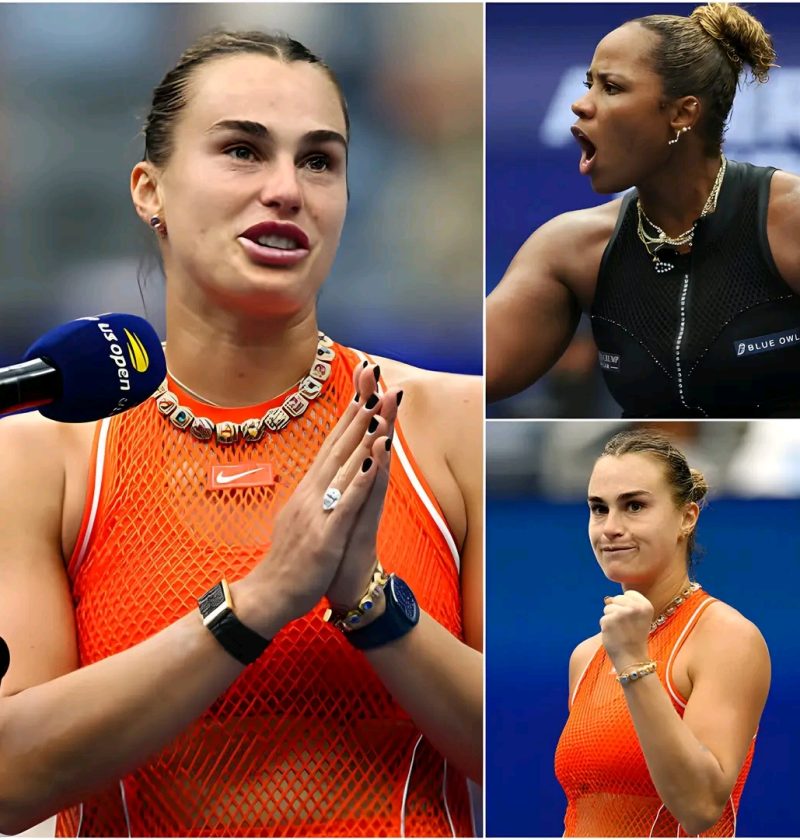
Aryna Sabalenka entered Arthur Ashe Stadium with huge expectations as the defending US Open champion and world No. 1, but her fourth-round clash with Taylor Townsend turned into a much tougher contest than many expected.
Townsend came into the match full of confidence after overcoming a difficult previous round. The American believed she had the ability to challenge one of the biggest names in women’s tennis and potentially produce a major upset.
From the beginning, Townsend showed that she was not intimidated. She played aggressively, moved forward whenever possible and tried to prevent Sabalenka from controlling the rallies from the baseline.
Sabalenka, however, quickly showed why she remains one of the tournament favorites. Her powerful groundstrokes consistently pushed Townsend deep behind the baseline, while her return game put serious pressure on the American during her service games.
The opening set was closely contested, with both players struggling at times to hold serve. Townsend managed to break Sabalenka early, giving the crowd hope that another major US Open surprise could be developing.
Sabalenka remained composed. Instead of rushing to finish points, she gradually increased the pressure and became more consistent with her attacking game.
The Belarusian eventually regained control and took the opening set 6-4.
Townsend refused to disappear in the second set. She again broke Sabalenka and moved ahead 3-1, putting herself in a position to potentially force a deciding set.
Her movement was impressive, and her willingness to come toward the net created problems for Sabalenka. The crowd continued to get behind the American as she looked for a way back into the match.
But Sabalenka responded like a champion.
The world No. 1 tightened up her game, stopped giving Townsend easy opportunities and began putting even more pressure on her opponent’s service games.
Sabalenka then won the final five games of the match to complete a 6-4, 6-3 victory.
Although the scoreline suggested a comfortable straight-set win, the match was much more competitive than the numbers indicated. Townsend had several opportunities to change the momentum, particularly in the second set, but Sabalenka consistently found answers.
The victory was another major milestone for Sabalenka at Flushing Meadows. She reached her sixth consecutive US Open quarterfinal and extended her winning streak at the tournament to 17 matches.
With Sabalenka chasing a historic third consecutive US Open championship, every victory becomes increasingly important.
However, much of the attention after the match focused on the alleged comments about Townsend.
Some reports and social media posts suggested that Sabalenka had dismissed Townsend by saying she was “not on my level.” That claim quickly generated controversy and attracted plenty of attention online.
But Sabalenka’s actual post-match comments were considerably more respectful.
Rather than attacking Townsend, Sabalenka praised her opponent and highlighted the qualities that made the match difficult. She specifically recognized Townsend’s ability to return serve, move around the court, come to the net and play fearlessly.
That makes the viral version of the story more complicated. A dramatic headline can easily take on a life of its own online, especially when a short comment is removed from its original context.
The article therefore points out that the alleged “not on my level” statement should not automatically be regarded as a confirmed quote from Sabalenka.
What is clear is that Sabalenka respected the challenge Townsend presented. She acknowledged that Townsend had made the match difficult and that overcoming such situations gave her additional confidence.
Townsend also had plenty to be proud of despite the defeat.
The American later explained that she had never felt more comfortable or confident playing against a world No. 1. Rather than viewing the loss simply as another disappointing exit, she saw the performance as evidence of her own progress.
Townsend entered the tournament carrying significant pressure, including ranking points that she needed to defend. She wanted to demonstrate that her previous success in New York was not simply a one-time achievement.
Her run to the fourth round showed considerable resilience. She handled the pressure of playing in front of the New York crowd, overcame difficult moments and continued building confidence in her singles career.
Her success in doubles has also helped develop her tactical understanding. That experience was visible against Sabalenka, particularly in her willingness to attack the net and search for opportunities to disrupt the rhythm of rallies.
But facing Sabalenka is an entirely different challenge.
The Belarusian can generate enormous power from almost anywhere on the court, meaning Townsend needed to remain aggressive while avoiding giving Sabalenka easy balls to attack.
Throughout the match, small moments proved decisive. Townsend created opportunities and occasionally looked capable of shifting the momentum, but Sabalenka repeatedly found ways to escape difficult situations.
That ability to adapt has become one of the most important parts of Sabalenka’s development.
She is no longer simply relying on overwhelming power. She has added greater patience, tactical awareness and emotional control to her game.
Earlier in her career, Sabalenka sometimes struggled when matches became emotionally difficult. In recent years, however, she has become much better at maintaining her composure under pressure.
That improvement was particularly important against Townsend, whose unusual style and frequent trips to the net disrupted the rhythm of the match.
Sabalenka ultimately stayed focused on one point at a time. Instead of becoming distracted by the crowd or Townsend’s changing tactics, she concentrated on controlling the areas of the match she could influence.
That mentality allowed her to close out another straight-set victory and gain further confidence as the tournament progressed.
Her next challenge will be even more demanding, with a quarterfinal matchup against Wimbledon champion Linda Noskova.
The pressure will continue to increase as Sabalenka gets closer to her goal of winning three consecutive US Open titles. Every remaining opponent will be determined to prevent her from making history.
Still, her battle with Townsend provided valuable evidence that Sabalenka can win even when she is not playing her most comfortable tennis.
She was behind 3-1 in the second set, yet she remained calm enough to completely turn the match around.
That resilience could become extremely important during the final stages of the tournament. Grand Slam champions do not always need to produce perfect tennis. Sometimes, they simply need to find a way to win when things are not going according to plan.
Against Townsend, Sabalenka did exactly that.
For Townsend, the defeat does not take away from the progress she made. Her performance demonstrated that she can compete with some of the best singles players in the world and create serious problems for even the strongest opponents.
The moment at the net after the match also provided an important contrast to the controversy surrounding the alleged comments. Despite the intensity of the contest, the two players embraced after the final point, showing mutual respect.
That moment served as a reminder that fierce competition does not necessarily mean personal hostility.
The supposed verbal confrontation may have created plenty of attention online, but the match itself told a more balanced story.
Sabalenka advanced because she handled the most important moments better, while Townsend showed that she belongs on the biggest stage and can challenge elite opponents.
For Sabalenka, the pursuit of another US Open championship continues.
For Townsend, the experience could become another important step in her development as a singles player.
Ultimately, Sabalenka’s 6-4, 6-3 victory secured her place in the quarterfinals, while Townsend left the tournament having earned plenty of respect.
Sabalenka remains on course for a potential historic three-peat, but the challenges will only become tougher from here. Every remaining opponent will be desperate to stop the defending champion before she can make history.