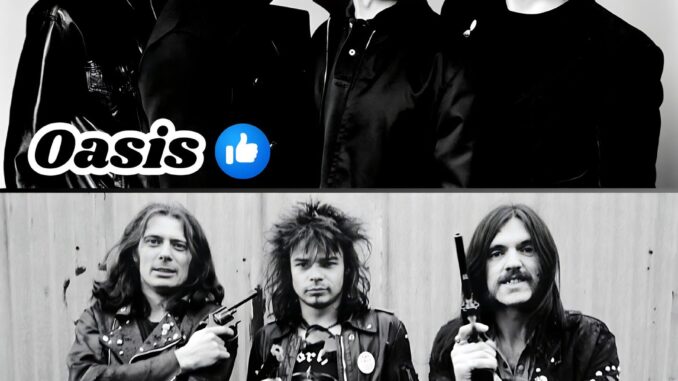
Oasis & Motörhead: The Uncompromising Spirit of British Rock That Defined Generations
Two bands. Two eras. One unshakable legacy. When it comes to defining British rock in all its swagger, rebellion, and raw authenticity, few names command more reverence than Oasis and Motörhead. Though their sounds could not be more different—the anthemic Britpop majesty of the Gallagher brothers versus the thunderous, no-holds-barred assault of Lemmy Kilmister’s metal machine—both acts captured the soul of rock ’n’ roll in its purest form: passion, attitude, and truth.
Oasis: The Britpop Kings Who Defined a Generation
In the mid-1990s, as the grunge wave from America began to fade, a new sound roared out of Manchester—bold, melodic, and unmistakably British. Oasis wasn’t just a band; it was a cultural explosion. Fronted by the volatile yet magnetic Liam Gallagher and driven by the songwriting genius of Noel Gallagher, Oasis resurrected rock stardom with a sense of pride, arrogance, and unfiltered emotion that resonated with millions.
Their 1994 debut album Definitely Maybe arrived like a lightning bolt, bursting with confidence and youthful defiance. Tracks like Live Forever and Supersonic spoke directly to working-class kids who saw themselves in Liam’s sneer and Noel’s swaggering guitar riffs. Oasis didn’t just play for the people—they were the people. Their music was an anthem for those who believed in dreams despite the struggle, for those who craved something real in a world that often felt cynical and cold.
Then came (What’s the Story) Morning Glory? in 1995—a masterpiece that turned them into global superstars. Wonderwall, Don’t Look Back in Anger, and Champagne Supernova became generational hymns, defining an era where British confidence was back in full force. Oasis’ songs were more than hits; they were emotional anchors—melancholic yet hopeful, simple yet eternal. Every chord and lyric carried the DNA of Lennon and McCartney filtered through the grit of Manchester streets.
But Oasis was more than their records—it was their attitude. Liam’s iconic stance behind the microphone, Noel’s deadpan wit, and their famously turbulent relationship became legend. Yet, that tension was also their magic. The Gallaghers embodied everything that made British rock great: ambition, authenticity, and unapologetic individuality.
Decades later, their music still fills stadiums, pubs, and playlists. Younger generations continue to discover Oasis as a symbol of truth in a world of filters and facades. Their legacy proves that real rock isn’t about perfection—it’s about passion, emotion, and the courage to believe you’re the best, even when the odds say otherwise.
As Noel Gallagher once said, “It’s a beautiful thing when you believe in something so much that nothing else matters.” That belief still echoes through every chord of Don’t Look Back in Anger.
Motörhead: The Relentless Sound of Pure Rock ’n’ Roll
While Oasis ruled the airwaves with melody and swagger, Motörhead ruled the underworld with thunder and fire. Founded in 1975 by the incomparable Lemmy Kilmister, Motörhead wasn’t just a band—they were a force of nature. Loud, fast, and unapologetically raw, they blurred the lines between punk, metal, and pure rock ’n’ roll.
Lemmy, with his gravelly voice, mutton chops, and Jack Daniel’s-fueled grin, became one of the most recognizable figures in rock history. His philosophy was simple: play it loud, play it real, and never back down. Motörhead’s music wasn’t polished—it was power, speed, and rebellion distilled into sound.
Their breakthrough came with Ace of Spades (1980), an anthem so powerful it became synonymous with the essence of rock itself. Fast, furious, and unforgettable, it captured everything Lemmy stood for: risk, defiance, and living life on your own terms. Songs like Overkill, Iron Fist, and Killed by Death cemented their status as pioneers who didn’t fit neatly into any genre—they simply created their own.
While other bands chased trends, Motörhead defined them. They were the bridge between punk’s raw energy and metal’s aggression, influencing generations of artists—from Metallica and Slayer to Foo Fighters and Guns N’ Roses. Yet, despite the chaos and volume, there was soul behind Lemmy’s snarl. Beneath the distortion was honesty—the kind that only comes from living on the edge and staring life straight in the face.
Offstage, Lemmy was as legendary as his music. Philosophical yet grounded, wild yet wise, he represented the last of a dying breed—a rock star who lived by his code. “We are Motörhead,” he would roar before every show, “and we play rock ’n’ roll.” It wasn’t just a statement—it was a promise.
Even after Lemmy’s passing in 2015, the spirit of Motörhead refuses to fade. Their legacy lives on in every band that dares to play faster, louder, and truer to themselves. They didn’t just change music—they changed what it meant to be real.
Two Legends, One Spirit
Oasis and Motörhead may have existed in different corners of the rock spectrum, but they were united by one unbreakable thread: authenticity. They didn’t care about trends or expectations—they made music for the love of it, for the truth in it, and for the fans who needed it.
Oasis gave us the soundtracks to our dreams; Motörhead gave us the soundtracks to our rebellion. Together, they remind us why rock matters—because it speaks to who we are at our core: imperfect, passionate, and unafraid to live loud.
Leave a Reply