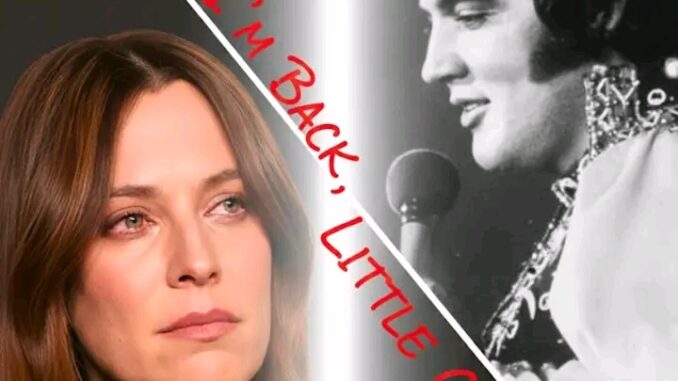
“I’M BACK, LITTLE GIRL” — Elvis Speaks to Riley Keough From Beyond in a Never-Before-Seen Performance**
In a hauntingly beautiful convergence of past and present, a never-before-seen performance has emerged that captures the ethereal voice of Elvis Presley reaching across the boundaries of time. The scene, both surreal and deeply emotional, features the legendary King of Rock ‘n’ Roll speaking directly to Riley Keough, his granddaughter, from beyond the grave, uttering the words, “I’m back, little girl.” This spectral encounter has ignited the imaginations of fans worldwide, stirring feelings of nostalgia, reverence, and a profound sense of connection to the Presley legacy.
Elvis Presley, whose influence on music and pop culture remains unmatched, left an indelible mark on the world when he passed away in 1977. Yet, his spirit, mythos, and music continue to resonate, inspiring new generations. Riley Keough, his granddaughter, has carved out her own career in acting, embodying a bridge between the Presley legend and contemporary culture. This unseen performance, reportedly recorded in a clandestine setting, offers a poignant moment where the boundaries between life and afterlife blur, bringing Elvis’s voice into the modern age in a way fans have only dreamed of.
The footage, which circulated initially through whispers among select circles before going viral online, shows Riley in a dimly lit room, seemingly in a meditative or reflective state. Then, a gentle, familiar vocal emerges—a voice unmistakably Elvis’s—intoning with warmth and a touch of the playful mischief that endeared him to millions. His words, “I’m back, little girl,” echo with both reassurance and a hint of mischief, suggesting a paternal affection that has transcended the physical realm.
This moment is layered with emotional complexity. For fans, it’s a reminder that Elvis’s presence persists beyond his earthly departure, that his spirit continues to watch over his family and fans alike. For Riley, it’s a deeply personal encounter, a symbolic affirmation of her roots and the enduring influence of her grandfather’s legacy. The phrase “little girl” is particularly evocative, hinting at the tender nickname Elvis often used for Riley when she was young, and now, in this spectral exchange, underscores the intimacy and enduring bond between them.
The origins of this performance remain shrouded in mystery. Some speculate it was a spontaneous spiritual experience, perhaps facilitated by advanced technology or a gifted medium. Others believe it’s a carefully crafted artistic homage, blending modern sound technology with archival audio and visual elements to simulate Elvis’s voice. Regardless of its genesis, the emotional impact is undeniable. It taps into a collective longing to connect with those who have departed, and in doing so, reaffirms the idea that love, memory, and influence transcend mortality.
Musically, Elvis’s voice carries a rich, warm timbre, instantly recognizable, evoking the raw emotion of his legendary recordings. His words are interwoven with subtle musical cues—perhaps a faint echo of “Unchained Melody” or “Can’t Help Falling in Love”—adding layers of nostalgia and reverence. The performance’s ethereal quality is enhanced by visual effects: soft lighting, shimmering overlays, and a gentle fade-in and fade-out that mimic the passage of time and the intangible nature of spirits.
The significance of this moment extends beyond its technical aspects. It prompts a reevaluation of the cultural and emotional significance of legacy, memory, and the afterlife. Elvis, often mythologized as a symbol of rebellion, romance, and raw talent, now takes on a new dimension—as a guardian angel watching over his family and fans, whispering words of reassurance and love from beyond the veil.
For Riley Keough, this encounter is likely a deeply personal experience. As an actress and model, she has long felt the weight of her heritage, navigating her own identity amidst the shadow of Elvis’s towering influence. To hear her grandfather’s voice, even in a spectral form, could serve as both comfort and inspiration—a reminder of her roots and the unbreakable bond of family. It also raises questions about how descendants interpret and carry forward their ancestors’ legacies in a rapidly changing world.
The performance’s release has sparked widespread discussion across social media, with fans expressing awe and emotion. Many see it as a beautiful tribute—a digital séance of sorts—that keeps Elvis’s spirit alive in the hearts of millions. Others ponder the technological marvels that made such a moment possible, contemplating whether this is a glimpse into the future of memorialization and remembrance.
In the end, the phrase “I’m back, little girl” resonates as both a literal and symbolic declaration. It signifies Elvis’s eternal presence, his love for Riley, and the enduring power of music and memory to bridge the gap between worlds. As viewers absorb this hauntingly beautiful moment, they are reminded that some spirits never truly leave us—they simply wait, watch, and sometimes, speak from beyond, whispering words of love that echo through eternity.
Leave a Reply